
A Victorian research group studied lamb growth rates in the late spring/summer 2004/2005 (Holmes et al. 2005).
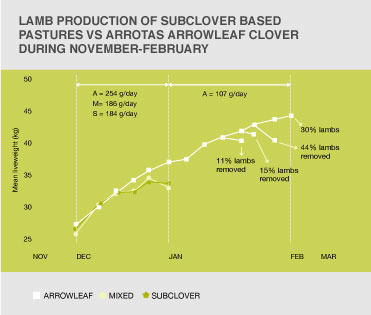
(Data courtesy DPI Vic)
Arrotas monocultures - 254g/day compared to;
- Subterranean monocultures - 184g/day
- Subterranean/perennial ryegrass mixes - 186g/day
Lambs grazing Arrotas continued to grow at more than 100g/day from January to mid February.
- By choosing Arrotas in preference to an earlier flowering Arrowleaf clover you gain benefits from an extra 29 days pasture growth rate resulting in the added bonus of an extra 3kg/head in the finishing weight of your lambs.
- Arrotas provides a benefit of an extra 10kg/head in the finishing weight of lambs over a Perennial ryegrass sub clover pasture mix.
- Annual
- Upright in its growth habit
- A low bloat risk
- Suited to a range of soil types providing they are well drained and a pH 5.0 to 7.0
- Suitable for hay or silage
- Arrotas Clover's ability to access moisture into summer in enhanced by a deep taproot. Sub clover has shallow roots. Winter production is poor compared to Sub, Persian and Balansa clovers but late maturing Arrotas is significantly more productive than these in late spring and early summer. Arrotas is adapted to cool Mediterranean/warm temperature climates that have dry summers.
Holmes J., Kennedy A., Thompson A. (2005) Arrowleaf clover growing lambs in late spring/summer in southwest Victoria. In 'Proceedings 46th Annual Conference of the Grassland Society of Southern Australia'. Ballarat.
Arrotas was developed for Tasmanian producers to take advantage of Tasmania’s long growing season.
Arrotas (at lat. 42’) flowers 29 days later than the next variety Zulu, 31 days later than Seelu and Zulu 11 and 43 days later than Cefalu.
With adequate moisture Arrotas will provide an extra four weeks of high quality feed compared to any other variety of Arrowleaf clover available in Australia.
Assuming growth rates of Arrotas are a conservative 70kg DM per day (Growth rates of 135 kgDM/day have been recorded for Arrotas ) over this four week period Arrotas will provide an extra 2t/ha in dry matter (DM) compared to other Arrowleaf clovers.
Valuing pasture at $60 per tonne this equals an extra return of $120 per hectare simply by choosing the later maturing variety Arrotas.
- Long growing season
- High yielding
- Self reseeding
- Bloat safe
- Deep taproot
- Moderate drought tolerance
- Increases soil nitrogen
Arrotas can provide high quality green feed for grazing animals late in the season when many other pastures have dried, but it has poor Winter production.
It can be used as a disease break crop or to produce high quality silage or hay (sward should not be cut for hay in the establishment year).
Arrotas is suited to high rainfall areas of 600mm+.
Best sown at a depth of about 5mm. Seed which is sown deeper than 10mm is unlikely to emerge.
Preferably sow late Summer to early Autumn for sufficient seedling development prior to Winter, but can be sown in Spring if the area receives Summer rainfall or irrigation is available over Summer.
10kg/Ha alone.
5kg/Ha in a mix.