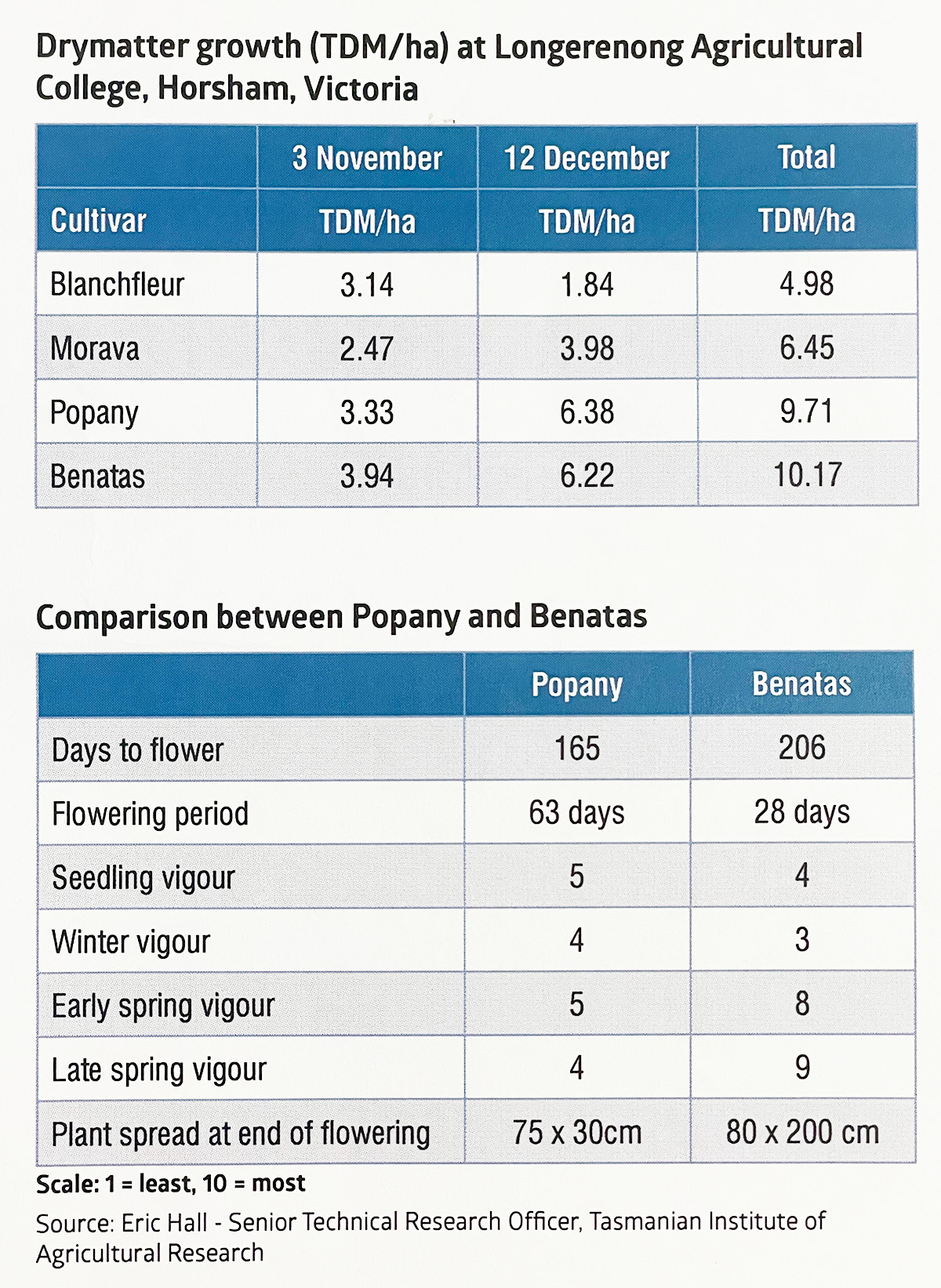
- Very high yielding
- Tolerant of moderate waterlogging
- Winter hardy to -7oC
- High quality hay or silage
- Excellent green manure - improving soil fertility
- Offers a weed and disease break for cereals in a crop rotation
- Tolerates both acid and alkaline soil conditions (pH 4.8-8.2)
A Winter growing annual with multiple laterals branching from the near base.
Benatas can be used as a pasture, for hay, silage or a green manure crop.
Growing Benatas in crop rotations can be a very good strategy for controlling resistant grass weeds, because it will be grazed or cut before grasses have formed or set seed.
It also provides a disease break from cereal diseases.
Benatas is adapted to warm temperature and Mediterranean climates.
It grows well in the rainfall range of 350-800mm.
It is very important to sow at a depth of 20-30mm to obtain optimal establishment. Benatas can also be sown on a rough seed bed and rolled in.
Sow mid April-May for early feed/grazing.
Drymatter production is significantly reduced if sowing is delayed to mid June, particularly in southern Australia.
20-40kg/Ha alone
10-15kg/Ha with 40-60kg/Ha of forage oats